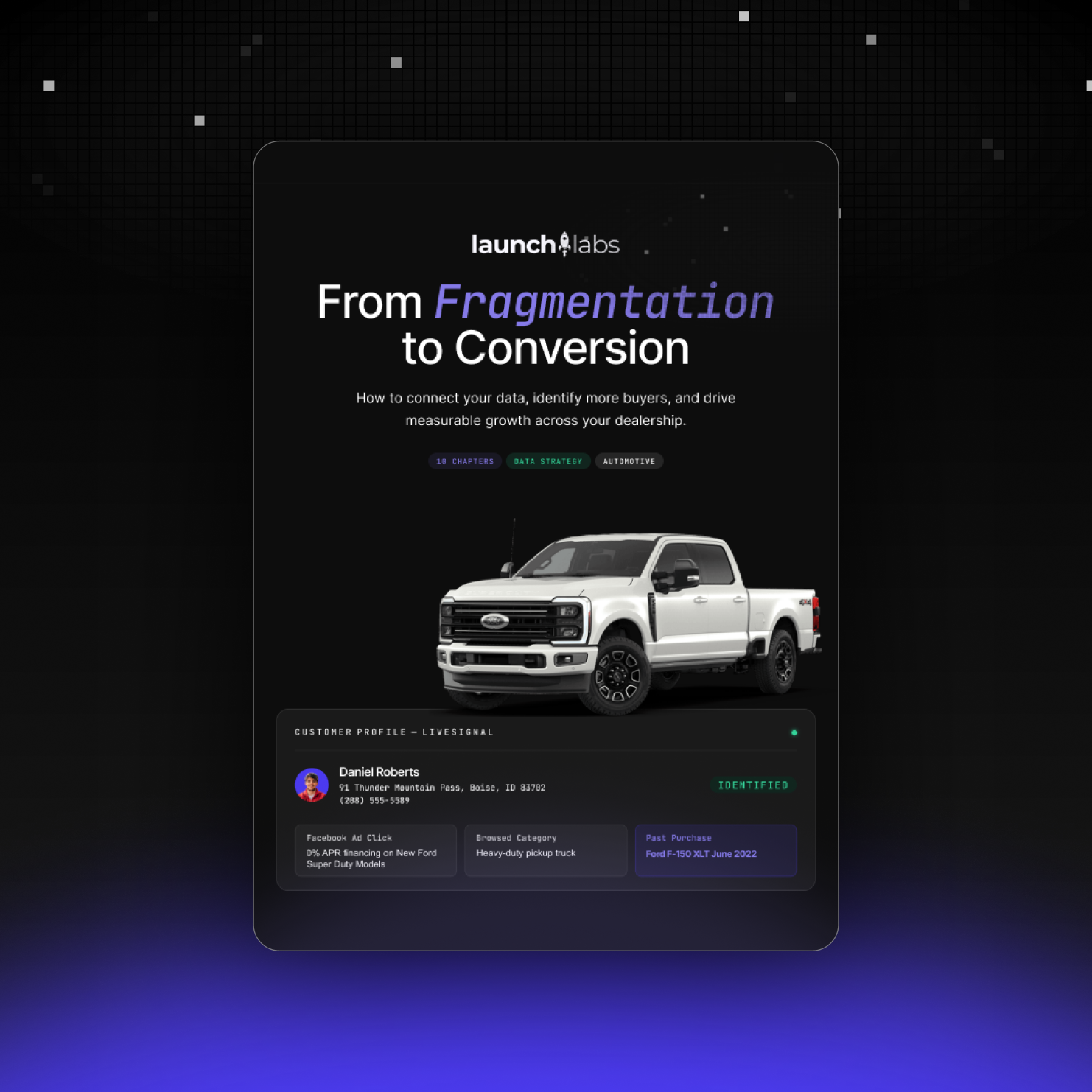
How to Connect Your Data, Identify More Buyers, and Drive Measurable Growth
Discover how automotive dealerships can connect fragmented customer data and enrich customer insights through identity resolution. Learn the keys to a modern data strategy that increases conversions, improves audience visibility, and drives stronger marketing performance.
Modern automotive dealerships have more customer data than ever before, but most struggle to turn that data into measurable growth. Between their CRM, DMS, website, and third-party data, dealership data often lives in disconnected silos that create fragmented customer experiences, inefficient marketing, missed sales, and inaccurate attribution.
This ebook explores how dealerships can move from fragmented systems to connected, identity-driven data strategies that improve marketing performance and conversion rates.
The Hidden Cost of Fragmented Dealership Data
Many dealerships believe they have a data problem when, in reality, they have a data connectivity problem. Customer records frequently exist across multiple disconnected systems, leading to duplicate profiles, inconsistent messaging, and anonymous website traffic that never converts.
Without a unified customer view, sales, marketing, and service teams operate independently, making it difficult to deliver personalized experiences or accurately measure performance.
Why Most Dealership Data Strategies Fail
The ebook highlights several common reasons dealership data initiatives fail, including:
- Investing in disconnected tools without a cohesive strategy
- Poor data quality caused by duplicates, outdated records, and missing attributes
- Activating on only a small portion of in-market shoppers
Rather than adding more data or tools, successful dealerships focus on creating a connected ecosystem where data flows seamlessly across systems.
Identity Resolution Is the Missing Layer
A major theme throughout the ebook is the importance of identity resolution, the process of connecting fragmented customer signals, identifiers, and interactions into a unified customer profile that can be activated across systems and channels.
Most dealerships rely primarily on deterministic identity methods, where website visitors are identified only after explicit actions such as form submissions, authenticated sessions, CRM matches, or engagement with dealership emails and campaigns. While effective for known customers, this approach limits visibility to a small percentage of total in-market shoppers.
Probabilistic identity resolution expands identification by leveraging persistent identifiers, device relationships, household connections, behavioral patterns, and other non-deterministic signals to recognize previously unknown visitors at scale.
By combining probabilistic identity resolution with deterministic methods, dealerships can significantly expand audience visibility, identify more in-market shoppers, improve attribution, and activate a much larger portion of their website traffic.
Privacy-First Identity
As third-party cookies disappear and privacy regulations continue to evolve, dealerships need new ways to identify and engage customers without relying on traditional tracking methods.
Modern identity strategies combine first-party data, probabilistic identity resolution, and privacy-safe collaboration to create actionable audience insights while protecting customer information. By connecting CRM systems, DMS data, website behavior, and other third-party data sources, dealerships can improve audience visibility while remaining privacy compliant.
The ebook also introduces concepts like data clean rooms, which allow dealerships to securely collaborate with third-party platforms and data partners without exposing raw personally identifiable information.
This shift toward privacy-first identity strategies is not limiting marketing effectiveness. It is reshaping how high-performing dealerships build audience visibility, improve attribution, and activate customer data in a privacy-first world.
The Modern Dealership Data Stack
The ebook outlines a four-layer framework for building a modern dealership data strategy:
- Data Foundation Layer for cleaning and enriching customer data
- Activation Layer (CDP) for real-time engagement and personalization
- Intelligence Layer (Data Warehouse) for analytics and reporting
- Identity Layer that connects and expands visibility across all systems
Together, these layers create a connected ecosystem where customer interactions can be captured, enriched, activated, analyzed, and optimized continuously.
Data Enrichment and Customer Intelligence
Incomplete or inaccurate customer data limits the effectiveness of every downstream marketing effort. Data enrichment helps dealerships:
- Eliminate duplicate records
- Fill missing customer attributes
- Improve audience segmentation
- Gain lifecycle-stage visibility
- Build more complete customer profiles
With stronger data quality, dealerships can deliver more personalized campaigns and make smarter marketing decisions.
CDP vs Data Warehouse: Action vs Insight
The ebook also explains the difference between a Customer Data Platform (CDP) and a data warehouse. While a CDP focuses on real-time activation and customer engagement, a data warehouse provides long-term storage, analytics, and business intelligence.
Together, they create a feedback loop where customer interactions generate insights, and those insights fuel smarter marketing actions.
Building a Connected Data Strategy
Dealerships that embrace modern data strategies can:
- Identify more customers across channels
- Improve personalization and engagement
- Increase marketing efficiency
- Create unified customer experiences
- Gain more accurate performance measurement
The future of dealership marketing belongs to organizations that can transform fragmented data into connected, actionable intelligence.
Want the full framework for building a connected dealership data strategy? Download the complete ebook to learn how identity resolution, data enrichment, CDPs, and analytics can help your dealership drive measurable growth and higher conversions.